
OnPoint AI
Our Technology
The OnPoint AR-AI Technology Platform is engineered to deliver industry-leading surgical guidance accuracy, enabling a new standard of precision in spine and orthopedic procedures.
OnPoint AR is an FDA-cleared augmented reality surgical navigation platform that projects virtual surgical guides and virtual implants directly onto the patient, right in the surgeon’s line of sight. Using a lightweight, high-resolution head-mounted display weighing less than four ounces, surgeons can visualize critical anatomy and plan implant placement in real time without ever looking away from the operative field. The result is a level of hand-eye coordination and intraoperative precision that traditional navigation systems and robotic platforms simply cannot match.
What sets OnPoint AR apart is how seamlessly it fits into existing surgical workflows. The system is open-platform and compatible with the implant systems and instruments of all major manufacturers, requiring no changes in surgical technique or surgeon practice. Whether in a hospital or ambulatory surgery center, OnPoint AR integrates with the tools already in the room, reducing barriers to adoption while delivering a decisive accuracy advantage, with peer-reviewed studies showing performance two to five times greater than leading navigation and robotic alternatives.
Backed by more than 15 granted U.S., China, and EU patents, OnPoint AR represents a new generation of surgical intelligence that combines augmented reality and artificial intelligence to support more controlled, repeatable procedures, more consistent outcomes across cases and teams, and a meaningful reduction in reliance on intraoperative radiation. This is technology built not to replace the surgeon’s judgment, but to sharpen it.
Download the OnPoint AR-AI Technology Specs
Explore the full capabilities of the OnPoint AR-AI Navigation Platform, including system configuration, workflow options, surgical benefits, and precision-guided technology designed for spine and orthopedic procedures.
Compelling Benefits
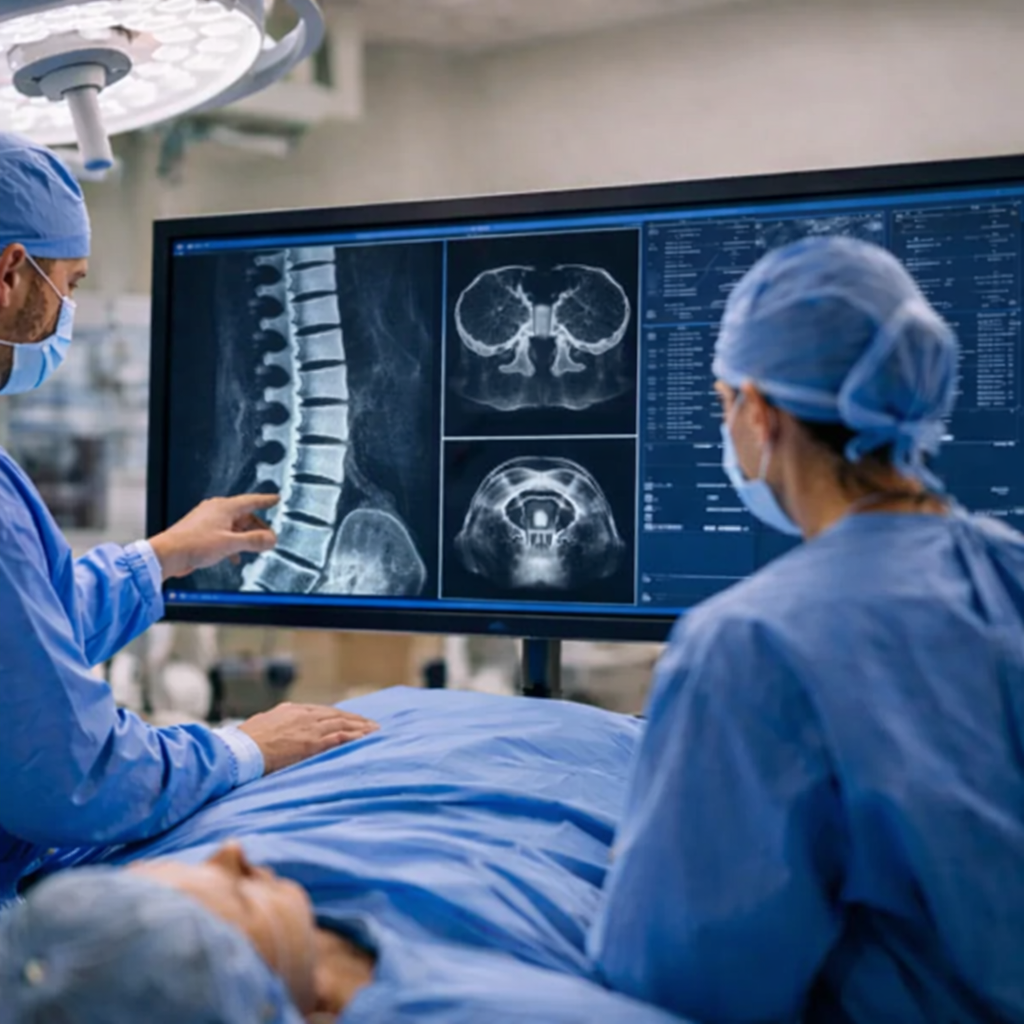
Applicable to a broad range of surgical procedures
Direct benefits for patients and surgeons, with a smooth path to adoption and minimal workflow disruption.

Potential for greater patient safety
Potential for less variability
Potential superior patient outcomes
Opportunity to decrease radiation exposure patient & surgeon
Reduces reliance on repeated intra-operative imaging by planning earlier in the process.
With use of pre-operative CT scan.
Uses pre-op CT planning to anticipate decisions while minimizing imaging during the case.
Potential to reduce OR time with use of pre-operative CT scan
Improves efficiency by bringing pre-defined information into the OR.
Estimated potential OR time reduction by 20 minutes compared to intra-operative spin (2).
Translates into measurable time savings per case, supporting higher throughput.
No change in surgeon practice, same surgical technique
Adoption does not require changing established surgical technique.
Respects all surgeon preferences.
Fits different surgeon styles and preferences without forcing a single approach.
Hospitals
Cutting-edge, highly accurate technology
Potential to increase procedural volume & revenue due to higher efficiency
Significant Cost Savings vs. Robotics
Delivers benefits without the overhead typically associated with robotic systems.
Implant vendor agnostic–avoid vendor lock in. Preserves purchasing flexibility and avoids being tied to a single vendor ecosystem.
Opportunity for better implant pricing. Supports stronger negotiating leverage through open compatibility.

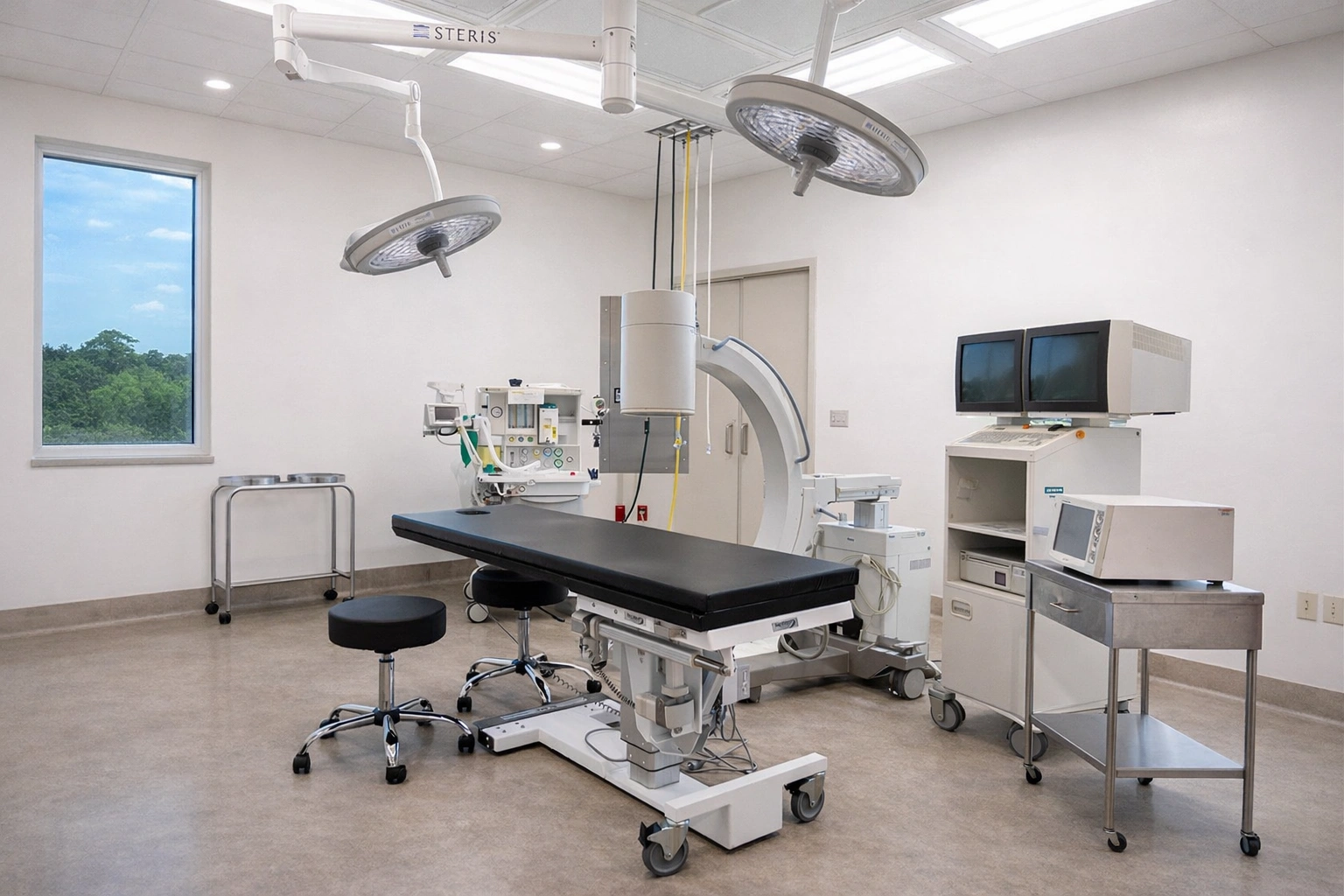
Ambulatory Surgery Centers (ASCs)
Space efficiency–single cart with small footprint
Attractive pricing
Compatibility with all existing intra-operative workflows
Unique vendor pricing power
Strengthens purchasing leverage while maintaining operational flexibility.
Open platform – works with implants of all major manufacturers.
Supports interoperability across major implant manufacturers.
Scalability for future expansion
Comparison
Why Surgeons Choose OnPoint AR
OnPoint's AR-AI surgical Navigation system
Frequently Asked Questions
What is the OnPoint AR-AI surgical navigation system?
The OnPoint AR-AI system is an advanced surgical navigation platform that combines augmented reality and artificial intelligence to guide surgeons during procedures. It overlays critical anatomical information directly onto the patient’s body using a head-mounted display, allowing surgeons to visualize structures and plan interventions in real time without looking away from the surgical field.
How does augmented reality improve surgical procedures?
Augmented reality enhances surgical procedures by providing real-time, patient-specific visual guidance directly within the surgeon’s field of view. Instead of relying on external monitors, surgeons can see anatomical landmarks, trajectories, and implant positioning overlaid onto the patient. This reduces cognitive load, improves hand-eye coordination, and enables more precise execution of complex tasks.
What are the key components of the OnPoint system?
The system includes optical head-mounted displays (OHMDs), a navigation and registration system with tracking capabilities, a server and user interface for planning, and a wireless network for communication between components. It is designed with a compact footprint, typically requiring only a small cart, making it easy to integrate into existing operating rooms.
Can the OnPoint system integrate with existing hospital equipment?
Yes, one of the core advantages of the OnPoint system is its interoperability. It is designed to integrate seamlessly with existing imaging systems, navigation tools, and even robotic platforms. This flexibility allows hospitals to adopt the technology without replacing their current infrastructure, reducing barriers to implementation.
How does the system support real-time surgical decision-making?
The system enables surgeons to plan and adjust procedures in real time by visualizing anatomy and implant positioning directly on the patient. Surgeons can simulate implant placement before making irreversible decisions, ensuring optimal size, alignment, and positioning. This dynamic feedback loop enhances intraoperative confidence and precision.
How does OnPoint preserve the surgeon’s natural workflow?
Unlike robotic systems that may impose rigid workflows, OnPoint adapts to each surgeon’s preferred technique. The system enhances the surgeon’s existing approach rather than replacing it, allowing for faster adoption and minimal disruption. This surgeon-controlled workflow ensures that technology supports, not dictates, the procedure.